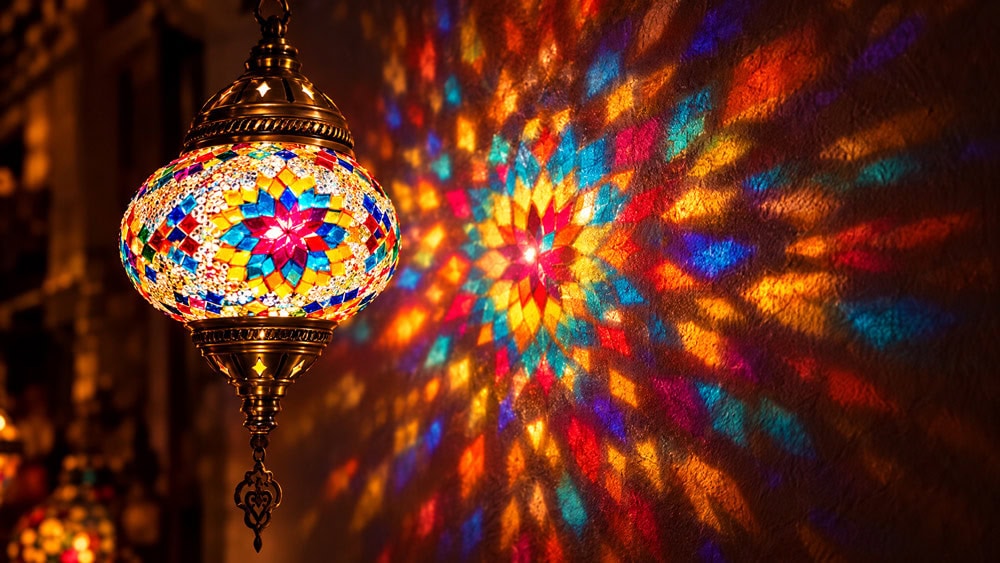
Few things change the feel of a room like the glow of a Turkish lantern. Switch one on at dusk and plain walls turn into a scatter of sapphire, ruby, and amber light. Hang three together over a dining table and the space suddenly feels like a corner of an Istanbul café. It's no surprise these lights have found a home in so many American living rooms, restaurants, and covered patios.
The name can be confusing, though. Shop online and you'll see the same word used for colorful mosaic glass globes, for pierced brass lanterns that throw star-shaped shadows, and for small candle lanterns made for a tabletop. Below, we explain what a Turkish lantern really is, where the style comes from, the main types you'll come across, how one is made by hand, and how to hang Turkish lanterns safely at home. We'll also show you how to make your own, because teaching this craft is what we do every week at Tiles Workshop.
Key Takeaways
- A Turkish lantern is a decorative light inspired by Ottoman design, built either around a mosaic glass globe or a pierced metal body.
- In the U.S., most shoppers mean the colorful mosaic glass style that hangs from a chain or sits on a small base.
- Hanging height matters: about 30 to 36 inches above a table, and at least 7 feet above the floor where people walk.
- A warm white E12 LED bulb gives the richest color and stays cool to the touch.
- You can make your own lantern in an afternoon with a DIY kit or a guided workshop, with no art experience needed.

What Is a Turkish Lantern?
A Turkish lantern is a decorative light inspired by Ottoman-era design, made either from a glass globe covered in colorful mosaic glass or from a metal body with cut-out patterns. It can hang from a chain, sit on a tabletop, or hold a candle. What every version shares is the same goal: to turn plain light into pattern and color.
Today the term covers two families of lights. Knowing which one you're looking at will help you choose, hang, and care for it the right way.
Mosaic Glass Lanterns
The mosaic glass lantern is the version most shoppers picture. It starts with a clear, rounded glass globe. A maker covers the outside with hundreds of small pieces of colored glass and tiny glass beads, then fills the gaps with grout so the pattern holds together. A metal cap and chain sit on top, and a small bulb glows inside.
When the light is on, it passes through the colored glass and fills the room with soft, jewel-toned light. These are the pieces you'll often see listed as Turkish glass lanterns or Turkish glass mosaic lanterns, and they come in single globes, clusters, and full chandeliers.
Pierced Metal and Candle Lanterns
The second family is older in spirit. These lanterns have a body of brass, copper, or tin with patterns punched or cut into the metal, sometimes with small colored glass panes set inside. Light escapes through the openings, so instead of colored glass you get crisp shadows of stars, arches, and teardrops across the walls and ceiling.
Many of these were made to hold a candle, and some still are. Others now come wired for a small bulb. They work beautifully on a porch, a patio table, or grouped on a mantel.

Where the Turkish Lantern Name Comes From
In Turkish, a lantern is called a "fener," the same word used for a lighthouse. In English, the words lantern, lamp, and light get mixed freely, which is why the same piece might be sold as a Turkish lantern, a Turkish lantern lamp, or a set of Turkish lantern lights.
A simple, practical rule helps: if it hangs from a chain or holds a candle, most people call it a lantern. If it stands on a base with a cord and a switch, most people call it a lamp. It's an informal line, not a strict one, and the craft behind both is often identical.
Turkish Lantern vs. Turkish Lamp: Is There a Difference?
The difference is mostly about form and use, not materials. A mosaic lantern and a mosaic table lamp can share the exact same handmade glass globe. One hangs, the other stands. A pierced metal lantern is a genuinely different object, with a different light effect.
If you'd like a deeper look at the table lamp side of this family, our guide to the Turkish Lamp covers its history, styles, and how it's made. Here's a quick side-by-side comparison:
| Feature | Mosaic Glass Lantern | Pierced Metal Lantern | Mosaic Table Lamp |
|---|---|---|---|
| Main material | Glass globe covered in mosaic glass and beads | Brass, copper, or tin with cut-out patterns | The same mosaic globe on a standing metal base |
| How the light looks | Soft, jewel-toned color | Sharp shadow patterns on walls and ceiling | Soft, jewel-toned color |
| Typical placement | Hanging from a chain or ceiling hook | Hanging, on the floor, or on a tabletop | Nightstand, console, or desk |
| Power source | Small electric bulb, often E12 LED | Candle or LED insert, sometimes wired | Plug-in cord with a switch |
| Best for | Color and atmosphere | Patios and dramatic shadows | Everyday accent lighting |

A Short History of Turkish Lanterns
The story begins with light in sacred and public spaces. In mosques across the Islamic world, oil lamps were traditionally hung from circular metal frames, suspended by chains looped through the sides of each lamp. According to the history of the mosque lamp, the Ottomans also produced lamps of a similar form in Iznik pottery. That image of glowing vessels hanging in rows from chains is still the blueprint for how these lanterns are displayed today.
Outside the mosque, lanterns lit homes, courtyards, and narrow streets. Metalworkers pierced brass and copper in geometric patterns, both for beauty and to let light and air move through the body of the lantern while a flame burned inside.
Trade spread these designs far and wide, and few places tell that story better than Istanbul's Grand Bazaar. Construction of the bazaar's core began in the winter of 1455 to 1456, and today it holds 61 covered streets and more than 4,000 shops. Walk its lanes now and you'll still find lantern shops glowing from floor to ceiling.
The colorful mosaic globe style that most people picture today is a newer chapter built on those older traditions. Workshops in Turkey combined the region's love of colored glass with the familiar hanging lantern form, and the result traveled the world. In the U.S., it has grown from a souvenir into a decor staple, and into a hands-on craft people love to learn.
Types of Turkish Lanterns
They come in more shapes than most people expect. Here are the main styles and where each one shines.
Hanging Lanterns and Pendants
Turkish hanging lanterns are the classic choice. A single Turkish lantern hanging from a short chain works as a pendant over a reading chair, a bathroom vanity, or a small entryway. Hanging Turkish lanterns look especially good in a corner that needs a focal point, because the colored light draws the eye without taking up any floor or table space.
Most hanging styles use a decorative brass-tone cap, a short chain, and a ceiling canopy or hook. We cover hanging height and safety in detail further down.

Turkish Lantern Chandeliers
A Turkish lantern chandelier gathers several globes, often three, five, seven, or more, on chains of different lengths. The staggered heights create a cascading cluster of color. These pieces make a statement over a dining table, in a stairwell, or in a living room with tall ceilings. Restaurants and event spaces love them for the same reason: a single fixture sets the whole mood.
Table and Floor Lantern Lamps
When a globe sits on a base instead of hanging, you get a Turkish lantern table lamp. These are ideal for nightstands, consoles, and desks. Floor versions stack several globes on a tall stand for corners and reading nooks. If you're drawn to making one, our turkish mosaic lighting kit includes everything you need to build a full-size table lamp at home.
Turkish Candle Lanterns
Turkish candle lanterns are smaller pieces that hold a tealight or votive. Some sit on a table, while Turkish hanging candle lanterns dangle from a hook on a porch or pergola. They create a gentle, flickering glow that's perfect for dinners and evenings outside. For a beginner-friendly project in this size, our turkish lamp kit lets you make a mosaic candle holder in one sitting. With any real flame, never leave it unattended, and consider a flameless LED candle when the lantern hangs near fabric or greenery.
Outdoor Lanterns
Turkish outdoor lanterns add instant atmosphere to a patio, balcony, or garden party. Pierced metal designs hold up best outdoors. Mosaic glass pieces are made for indoor use, so treat Turkish lanterns outdoors as a covered-porch or special-occasion decoration and bring them inside when rain, frost, or strong wind is on the way.
How Is a Turkish Lantern Made?
A traditional mosaic Turkish lantern is made entirely by hand, one piece of glass at a time. The process explains why no two are ever exactly alike.
It starts with a clear glass globe. The maker plans a pattern, often built around stars, diamonds, flowers, or waves, then applies clear glass adhesive to a small section of the globe. Pieces of colored glass, cut into squares, diamonds, and triangles, go down one by one following the curve of the glass.
Once the main shapes are in place, the gaps are filled with tiny glass seed beads. These beads lock the design together and add sparkle when the light comes on. After the adhesive dries, the whole surface is grouted and wiped clean, so the glass shines through. Finally, the finished globe is fitted with a metal cap, a chain or base, and a bulb socket.
This is the same craft behind Turkish mosaic lanterns sold around the world. A single small globe can hold hundreds of pieces, and the slight variations in color and spacing are the signature of a handmade piece, not a flaw. If the history of the medium interests you, our guide to Mosaic Art traces it back thousands of years.

How to Make a Turkish Lantern
If you've ever wondered how to make a Turkish lantern yourself, the good news is that it's far more doable than it looks. Turkish lantern making takes patience rather than artistic skill, and the hands-on part fits into a single afternoon.
What you'll need:
- A turkish lamp glass globe (ours measures 5.12 inches, or 13 cm)
- Mosaic glass tiles in square, diamond, and triangle shapes from our Turkish lamp parts and supplies
- glass seed beads to fill the gaps
- mosaic tile adhesive, a clear glass glue
- mosaic tile grout and a soft sponge
- A mosaic lamp base or hanging cap and chain
- A warm white bulb for turkish lamp (E12 LED, 3W)
Step 1: Plan your design. Pick two or three main colors plus an accent. Lay out your tiles and beads on a flat surface so you can see the full pattern before anything is glued.
Step 2: Clean the globe. Wipe the glass so it's free of dust and fingerprints. A clean surface helps the adhesive grip.
Step 3: Apply adhesive in small sections. Spread a thin layer of clear glue over an area about the size of your palm. Small sections keep the glue workable.
Step 4: Place your glass tiles. Set the larger pieces first, following your pattern around the curve of the globe. Leave tiny gaps between pieces for the beads and grout.
Step 5: Fill the gaps with beads. Press seed beads into the open spaces. This step is slow and calming, and it's where the lantern really comes alive.
Step 6: Let it dry. Give the adhesive about 12 hours to set fully before grouting.
Step 7: Grout and wipe. Mix the grout to a smooth paste, work it into the gaps, then wipe the glass clean with a damp sponge so the colors show through.
Step 8: Assemble and light it. Attach the globe to its base or hanging cap, add the bulb, and switch it on.
Prefer to have everything in one box? Our mosaic lamp kit and turkish mosaic lamp kit come with pre-sorted glass, beads, adhesive, and step-by-step instructions. And if you'd rather learn in person, a mosaic lantern class at our Mosaic Lamp Workshop walks you through every step with an instructor by your side.

How to Hang Turkish Lanterns
Knowing how to hang Turkish lanterns well comes down to three things: the right height, a safe power and mounting setup, and a thoughtful arrangement. Get those right and even a single globe looks intentional.
Choosing the Right Height
Height depends on what's underneath the lantern:
- Over a dining table or kitchen island: hang the bottom of the globe about 30 to 36 inches above the surface. The light falls where you need it and no one bumps their head.
- In walkways and entries: keep the bottom of the lantern at least 7 feet above the floor so people can pass comfortably.
- In corners and beside chairs: you have more freedom here. Lower placement feels cozy, as long as the lantern is out of the way of foot traffic.
- In bedrooms: a pair of hanging lanterns on either side of the bed can replace nightstand lamps and free up surface space.
Bulbs, Wiring and Safety
Most mosaic lanterns use a small E12 (candelabra) bulb. We recommend a warm white LED, because it brings out the depth of the colored glass and produces very little heat. A Turkish lantern bulb in the 3W range is plenty for accent lighting.
For power, you have two options. A plug-in swag kit runs the cord from the lantern up to a ceiling hook and across to a wall outlet, so no electrical work is required. A hardwired setup connects directly to a ceiling junction box and should be installed by a licensed electrician.
Whichever you choose, secure the hook properly. Screw it into a ceiling joist or use an anchor rated for the weight of the fixture, especially for a multi-globe chandelier. If you're hanging candle lanterns, keep them well clear of curtains, plants, and fabric.
Grouping Several Lanterns
Clusters are where these lights truly shine. A few simple rules help:
- Work in odd numbers, such as three or five, for a more natural look.
- Stagger the heights by about 4 to 10 inches so the globes don't line up in a flat row.
- Mix sizes or colors, but repeat at least one color across the group to tie it together.
- Keep enough space between globes so each pattern stays visible on the walls.
How to Choose the Right Lantern for Your Space
The right Turkish lantern depends on the room, the mood you want, and how much color your space can carry.
Start with color. Blue and turquoise feel calm and cool, a natural fit for bedrooms and bathrooms. Red, orange, and amber feel warm and social, ideal for dining areas and living rooms. Multicolor designs work almost anywhere and are the easiest way to add personality to a neutral room.
Next, think about scale. A single small globe suits a nook or vanity. A three-globe cluster fills the space over a small dining table. A full chandelier needs room to breathe and looks best with taller ceilings. Handmade Turkish mosaic lanterns often range from around $40 for a single small globe to well over $300 for multi-globe floor lamps and chandeliers.
Finally, consider how the light will behave. Turkish lantern lights cast color onto nearby surfaces, so pale walls and ceilings show the pattern best. For more ideas on placing and pairing lights, our guide to Lamp Decorating walks through every room in the house. And if you'd like to browse the styles you can build yourself, explore our collection of turkish lamps.

How to Care for Your Lantern
A Turkish mosaic lantern needs very little care to keep glowing for years.
- Dust gently. Use a soft, dry cloth or a soft brush every week or two. Avoid soaking the globe or using harsh cleaners, which can dull the grout.
- Handle it by the frame. Lift by the cap, chain, or base rather than squeezing the glass.
- Check the bulb. Use the same E12 size and stick with low-heat LEDs. If a lantern flickers, check that the bulb is seated firmly before anything else.
- Look for loose pieces. If a bead or tile ever pops off, a dab of clear glass adhesive puts it right back.
- Protect it from weather. Bring mosaic pieces indoors before storms or freezing nights.
Create Your Own Lantern with Tiles Workshop
At Tiles Workshop, we believe the most meaningful lantern in your home is the one you made yourself. Our hands-on experience lets you craft your own masterpiece using the same techniques described above, guided by friendly instructors and surrounded by warm hospitality.
Each Mosaic Lamp Workshop runs about 2 to 2.5 hours, and every guest goes home with a finished piece they designed. All materials are included, no experience is needed, and complimentary Turkish tea and baklava are part of every session. It's a favorite for date nights, birthdays, bachelorette parties, and team outings.
Planning something for a crowd? Our Group Events bring the workshop to your team, friends, or family, starting at five guests. If you'd rather create at home, our DIY kits ship with everything you need. And if you're searching for Turkish lanterns near me, reach out through our Mosaic Art Classes Near Me page to find the next workshop in your area and book your spot.

Frequently Asked Questions
How do you hang Turkish lanterns?
Start by securing a hook into a ceiling joist or a weight-rated anchor, then hang the lantern by its chain at the right height. Over a dining table or kitchen island, the bottom of the globe should sit about 30 to 36 inches above the surface. In walkways, keep it at least 7 feet above the floor. For power, use a plug-in swag kit that routes the cord to a wall outlet, or have a licensed electrician hardwire it to a ceiling box. When hanging several lanterns, group them in odd numbers and stagger their heights by about 4 to 10 inches for a natural, cascading look.
How do you make a Turkish lantern?
Start with a clear glass globe, colored mosaic glass tiles, glass seed beads, clear glass adhesive, grout, a base or hanging cap, and an E12 bulb. Plan your pattern, then glue the larger tiles to the globe in small sections, leaving tiny gaps. Fill the gaps with beads, let the adhesive dry for about 12 hours, then grout and wipe the glass clean. Finally, attach the globe to its base or cap and add the bulb. A DIY kit or a guided workshop makes the process easy for complete beginners, and the hands-on part takes just a few hours.
What is the difference between a Turkish lantern and a Moroccan lantern?
A Turkish lantern most often refers to a glass globe covered in colorful mosaic glass and beads, which casts soft, jewel-toned light. A Moroccan lantern is usually built from pierced or cut metal, sometimes with colored glass panels, and throws sharp shadow patterns across the room. The two traditions share roots in the wider Islamic and Mediterranean world, and shops often use the names loosely, so you'll sometimes see mosaic globes labeled Moroccan and metal lanterns labeled Turkish. The simplest way to tell them apart is to look at how the light passes through: colored glass or cut-out metal.
What bulb does a Turkish lantern use?
Most mosaic lanterns use a small E12 candelabra-base bulb. We recommend a warm white LED of around 3 watts, which produces enough light for an accent piece while staying cool to the touch, a real benefit for a handmade glass globe. Warm white brings out the depth of reds, ambers, and blues, while cool white can make the glass look flat. Always match the bulb base to the socket and stay within the wattage listed for your fixture. For pierced metal lanterns, check whether the piece is wired or designed for a candle or LED insert before buying a bulb.
Can Turkish lanterns be used outdoors?
Turkish lanterns can be used outdoors with some care. Pierced metal lanterns, especially those made for candles or LED inserts, are the best choice for patios, porches, and gardens. Mosaic glass lanterns are designed for indoor use, so they work outdoors only in sheltered spots such as a covered porch or pergola, and only for occasional use. Rain, frost, and strong sun can loosen grout and stress the glass over time. If you love the mosaic look outside, use it for evening gatherings and bring the lantern back inside afterward, and never run an indoor plug-in cord through standing water or wet areas.
Are Turkish lanterns handmade?
Yes, authentic mosaic lanterns are handmade. Each one starts as a clear glass globe that a maker covers with hundreds of small pieces of colored glass and glass beads, placed by hand one at a time and then grouted. Because every piece is set individually, no two lanterns are exactly alike, and small variations in spacing or color are part of the charm. Pierced metal lanterns are also traditionally shaped and punched by hand, though mass-produced versions exist. If handmade quality matters to you, look for slight irregularities in the pattern, or make your own at a workshop.
Can you put a candle in a Turkish lantern?
Yes, as long as the lantern is designed for one, such as a pierced metal candle lantern or a mosaic candle holder. These have an open top or vents that let heat escape. Do not place a real candle inside an electric mosaic lantern, since the globe is not built for an open flame and the heat can damage the adhesive and grout. For hanging pieces near fabric, plants, or wood, a flameless LED candle gives a similar flicker with no fire risk. Whenever you use a real flame, keep it on a stable surface and never leave it unattended.
Where can I find Turkish lanterns near me?
You can find Turkish lanterns at home decor stores, specialty import shops, and online sellers, and you can also make your own at a local workshop. Hands-on mosaic lantern and lamp workshops are now offered in many U.S. cities, where you design a piece from start to finish and take it home the same day. At Tiles Workshop, we host sessions across Texas, the Midwest, and beyond, and we can also bring a private workshop to your venue for groups. Contact us to find the next date near you, or order a DIY kit to create one at home.
Bring the Glow of a Turkish Lantern Home
A Turkish lantern is more than a light. It carries centuries of craft in every piece of glass, from the chained lamps of Ottoman mosques to the glowing shop fronts of the Grand Bazaar. Whether you choose a single hanging globe, a cascading chandelier, or a flickering candle lantern for the patio, the right height, a warm LED bulb, and a little care will keep it glowing for years.
And if you'd like a piece that tells your own story, we'd love to help you make it. Join us for a Mosaic Lamp Workshop, plan a celebration through our Group Events page, or pick up a kit and start your artistic journey at home. Your first handmade lantern might just become your favorite light in the house.