Imagine standing inside the Hagia Sophia, looking up at golden walls that have shimmered for over 1,500 years. Or walking through Pompeii, where a single floor mosaic made from over a million tiny stones still depicts a battle that happened more than 2,300 years ago. These aren't just decorations, they're proof that mosaic art is one of the most enduring and powerful forms of human creative expression ever invented.
In this complete guide, we'll explore what mosaic art truly is, where it came from, the techniques that bring it to life, the materials and tools you need to start, and how this ancient craft continues to thrive today, including through the glowing Turkish mosaic lamps we craft and teach at Tiles Workshop. Whether you're researching for school, planning your first mosaic art workshop, or simply curious about this timeless art form, you'll find everything you need right here.
Key Takeaways
- Mosaic art is the practice of creating images, patterns, or surface decorations using small pieces of colored stone, glass, ceramic, or other materials called tesserae.
- The earliest known mosaic art dates back to ancient Mesopotamia around 3,000 BCE, making it one of the oldest art forms still practiced today.
- The three classical types of mosaic art are opus tessellatum, opus vermiculatum, and opus sectile, though modern artists often classify mosaics by material (glass, stone, ceramic).
- Famous mosaic art examples include the Alexander Mosaic in Pompeii, the Hagia Sophia mosaics in Istanbul, Ravenna's Byzantine masterpieces, and Antoni Gaudí's Park Güell in Barcelona.
- Mosaic art for beginners is more accessible than ever through mosaic art kits, hands-on workshops, and traditional techniques like Turkish lamp-making that anyone can learn in a single session.

What Is Mosaic Art? Definition and Meaning
Mosaic art is the technique of creating images, decorative patterns, and surface designs by arranging small fragments of colored materials, stone, glass, ceramic tiles, shells, beads, or even mirror, onto a prepared base, then securing them with adhesive or mortar. Each individual piece is called a tessera (plural: tesserae), and together these fragments form something far greater than the sum of their parts.
What sets mosaic art apart from painting or drawing is something almost magical: light. Where a painter blends pigments to create a single smooth surface, a mosaic artist works with hundreds or thousands of tiny reflective pieces. Each tessera catches light from a slightly different angle, so the finished work seems to shimmer and shift as you move around it. This is why Byzantine artists chose mosaic above all other media to depict the divine, no other art form captures luminosity quite like it.
Mosaic Art Meaning Across Cultures
The word "mosaic" itself carries beautiful symbolism. It traces back through Italian mosaico and Medieval Latin musaicum to the Ancient Greek word Mouseion, the shrine of the Muses, the goddesses of artistic inspiration. So when you create a mosaic, you're literally making "work of the Muses." The same root gives us our modern word "museum."
Across cultures, mosaic art meaning has always carried a powerful metaphor: unity from fragments. Take broken pieces, arrange them with patience and intention, and create something whole, beautiful, and lasting. This idea has resonated across thousands of years and continues to inspire artists, hobbyists, and entire communities today.
Why Mosaic Art Endures
Few art forms have survived as continuously as mosaic art. While paintings fade, papers crumble, and even sculptures erode, mosaics made from stone and glass can last for thousands of years with minimal damage. The Roman pavements buried under volcanic ash at Pompeii emerged in the 18th century looking nearly as vivid as the day they were laid. This permanence isn't just a technical curiosity, it's part of the art's deeper appeal. When you create a mosaic, you're making something built to outlast you.

Hagia Sophia, Istanbul, Turkey (Nick Kwan)
Where Did Mosaic Art Originate? A Journey Through History
The story of where mosaic art originated takes us across continents and through more than five millennia of human creativity. Let's trace its remarkable journey.
Mesopotamia: The Birthplace of Mosaic Art (Around 3,000 BCE)
The oldest known mosaic art comes from ancient Mesopotamia, roughly modern-day Iraq, around the third millennium BCE. The Sumerians of Uruk decorated temple columns by pressing thousands of long terra-cotta cones, painted in red, black, and white, into mud-brick walls to form striking geometric zigzag and diamond patterns. At the temple of Abra, archaeologists uncovered some of the earliest mixed-material mosaics ever made, combining colored stones, shells, and ivory.
One of the most stunning early examples is the Standard of Ur, a wooden box from around 2,500 BCE inlaid with shell, red limestone, and lapis lazuli set in bitumen. Its scenes of Sumerian armies and royal feasts are among the earliest narrative artworks in human history.
Greek Pebble Mosaics (8th–4th Century BCE)
Greek artisans transformed mosaic art by adopting natural river pebbles to create elaborate floor designs. The earliest pavement mosaics appeared at Gordium in western Asia Minor around the 8th century BCE. By the 4th century BCE, Greek workshops at Pella, the capital of Macedonia and birthplace of Alexander the Great, had perfected pebble mosaics so refined they could depict hunting scenes, mythological figures, and intricate floral borders.
Greek artists soon invented a revolutionary innovation: the tessera. Instead of using rounded pebbles, they cut small cubes of stone, glass, and ceramic to fit precisely together. This breakthrough is the foundation of nearly all mosaic art that came after.
The Roman Empire: Mosaic Goes Mainstream
When Rome rose to power, mosaic art went mainstream. From the 1st century BCE onward, Roman builders covered the floors and walls of villas, public baths, temples, and forums across the empire with mosaics. The most celebrated famous mosaic art from this era is the Alexander Mosaic from the House of the Faun in Pompeii, dating to around 100 BCE. Composed of more than one million tesserae, it depicts Alexander the Great defeating the Persian king Darius III.
Other extraordinary Roman mosaic art examples include the Villa Romana del Casale in Sicily, with over 3,500 square meters of mosaic flooring (including the famous "Bikini Girls" room depicting female athletes), and the playful "Cave Canem", Beware of the Dog, mosaics that greeted visitors at Pompeii's doorways.
Byzantine Glory: The Golden Age of Mosaic Art
If Rome made mosaic art popular, the Byzantine Empire made it sacred. From the 4th to 15th centuries, mosaic became the dominant pictorial art of the Christian world. Byzantine craftsmen developed gold-leaf glass tesserae, made by sandwiching real gold leaf between two layers of clear glass, and set them at deliberately uneven angles to catch and scatter candlelight. The result was walls that genuinely seemed to glow from within.
The most spectacular Byzantine mosaic art survives in two places. The first is Ravenna, Italy, where eight UNESCO-protected monuments preserve mosaic art from the 5th and 6th centuries, including the Mausoleum of Galla Placidia, the Basilica of San Vitale (with its iconic portraits of Emperor Justinian and Empress Theodora), and the Basilica of Sant'Apollinare Nuovo.
The second is Hagia Sophia in Istanbul, built in 537 CE. Its mosaics span centuries, but the most celebrated is the Deësis mosaic from around 1261, depicting Christ flanked by the Virgin Mary and John the Baptist. Many art historians consider it the single finest piece of mosaic art ever created.
Islamic Mosaic Traditions
Early Islamic art absorbed Byzantine techniques and reinvented them. The Dome of the Rock in Jerusalem, completed in 691–692 CE, remains the oldest surviving Islamic monument and contains breathtaking mosaic interiors. Because Islamic religious art generally avoids depicting human figures, artists developed extraordinarily complex geometric and floral designs that influenced mosaic art across the Middle East, North Africa, and the Mediterranean for centuries to come.
This Islamic geometric tradition is the direct ancestor of Moroccan zellige tilework, Persian patterns, and, as we'll see later, the Turkish mosaic lamps still handcrafted today.
Modern Revival: From Gaudí to Today
After the Renaissance shifted attention toward painting, mosaic art went through a quieter period, until the late 19th century, when Catalan architect Antoni Gaudí transformed it. His technique called trencadís, which uses broken pieces of ceramic tile and glass to cover sweeping curved surfaces, can be seen at Park Güell, Casa Batlló, and the Sagrada Família in Barcelona.
The 20th and 21st centuries brought mosaic art to public spaces, subway stations, and home interiors all over the world. Mexico City's National Autonomous University library, designed by Juan O'Gorman, remains the largest mosaic-covered building on Earth. Meanwhile, smaller-scale mosaic art studio spaces have flourished, teaching ancient techniques to new generations of beginners and professionals.

Famous Mosaic Art Examples Around the World
When people search for the most famous mosaic art in the world, the same masterpieces appear again and again. Here's a curated list of the most significant mosaic art examples every art lover should know.
Most Famous Ancient Mosaic Art
- The Alexander Mosaic (Pompeii, c. 100 BCE) — Often called the most famous mosaic in the world, this Roman floor mosaic depicts Alexander the Great's victory at the Battle of Issus and contains over one million tesserae.
- The Standard of Ur (Mesopotamia, c. 2,500 BCE) — One of the oldest surviving examples of narrative mosaic art, now housed in the British Museum.
- The Madaba Map (Jordan, 6th century CE) — The oldest surviving cartographic mosaic, depicting the Holy Land in over two million tesserae.
- The Justinian and Theodora Panels (Ravenna, c. 547 CE) — Pinnacle of Byzantine imperial portraiture in mosaic art.
- The Hagia Sophia Deësis (Istanbul, c. 1261) — Widely considered the finest mosaic art ever made.
- The Villa Romana del Casale (Sicily, 4th century CE) — Largest in-situ collection of Roman mosaics in the world.
- The Dome of the Rock interiors (Jerusalem, 691–692 CE) — Oldest surviving Islamic mosaic art.
Most Famous Modern Mosaic Art
- Park Güell (Barcelona, 1900–1914) — Antoni Gaudí's iconic trencadís installations, including the multicolored salamander known as "El Drac."
- Watts Towers (Los Angeles, 1921–1954) — Simon Rodia's seventeen interconnected towers covered in porcelain, glass, and shells.
- The Tarot Garden (Tuscany, 1979–1998) — Niki de Saint Phalle's monumental sculptures based on tarot cards.
- Magic Gardens (Philadelphia) — Isaiah Zagar's sprawling outdoor installation transforming an entire city block.
If forced to pick the single most famous example, the Alexander Mosaic typically wins by reputation, but the Hagia Sophia mosaics arguably represent the highest artistic achievement the medium has ever reached.

From Wikipedia
What Are the Three Main Types of Mosaics?
When students and beginners ask what the three main types of mosaic art are, they're usually asking about the classical Greco-Roman classification system. These three traditional categories defined how mosaics were made for nearly two thousand years.
1. Opus Tessellatum
This is the "standard" technique most people picture when they think of mosaic art. Square or rectangular tesserae, typically 4 millimeters or larger, are laid in straight, even rows to fill backgrounds, borders, and large fields of color. Opus tessellatum served as the workhorse of Greek, Roman, and Byzantine mosaic art for floors, walls, and ceilings.
2. Opus Vermiculatum
The Latin name comes from vermiculus, meaning "little worm", a reference to the wavy, undulating rows of tesserae that curve around figures and faces to create lifelike detail and shading. Opus vermiculatum uses much smaller tesserae (often 1–4 mm) than opus tessellatum and was reserved for the most important focal points: portraits, mythological figures, animals, and central panels called emblemata.
3. Opus Sectile
This technique departs from the cube-shaped tesserae entirely. Instead, large pieces of stone, marble, or glass are cut into specific custom shapes, stars, leaves, animals, letters, or anything else, and fitted together like an intricate jigsaw puzzle. Opus sectile is the direct ancestor of Florentine pietra dura inlay and remains popular for grand decorative floors.
A fourth term you'll often encounter is opus musivum, which refers to wall and ceiling mosaics made from glass smalti, the gold-backed Byzantine masterpieces.
It's worth noting that many modern teachers and mosaic art studio instructors classify mosaics differently, by material rather than technique. Under that system, the three main types of mosaic art are stone/marble mosaics, glass mosaics, and ceramic mosaics. Both classifications are valid; just be aware which one is being used in any given context.

Other Types of Mosaic Art You Should Know
Beyond the three classical categories, mosaic art encompasses a rich variety of styles, materials, and traditions worth exploring.
Glass Mosaic Art (and Smalti)
Glass mosaic art, sometimes called mosaic glass art or mosaic art glass, uses translucent or opaque glass pieces to achieve unmatched color brilliance. The most prized form is smalti, which is opaque hand-cut Italian glass made by pouring molten glass paste into "pizzas" and chiseling them into rough, light-catching tesserae. Glass mosaic art dominates Byzantine, modern decorative, and Turkish lamp traditions.
Ceramic and Stone Mosaics
Ceramic mosaic art tiles offer affordability and durability, making them popular for kitchens, bathrooms, and outdoor installations. Stone and marble mosaics have been the foundation of pavement mosaic art since antiquity, prized for their natural color variations and longevity.
Trencadís (Broken Tile Mosaic)
Pioneered by Antoni Gaudí in 1880s Barcelona, trencadís uses irregularly broken pieces of ceramic, glass, and tile to cover three-dimensional curved surfaces, something traditional flat tesserae struggle to accomplish. This style is also known as pique assiette in French.
Micromosaic
Developed in the Vatican Mosaic Studio starting in 1727, micromosaic uses tesserae as small as 1 millimeter to create incredibly detailed miniatures. By the 1800s, micromosaic brooches and pendants were among the most sought-after souvenirs of the Grand Tour.
Turkish Mosaic Lamp Art
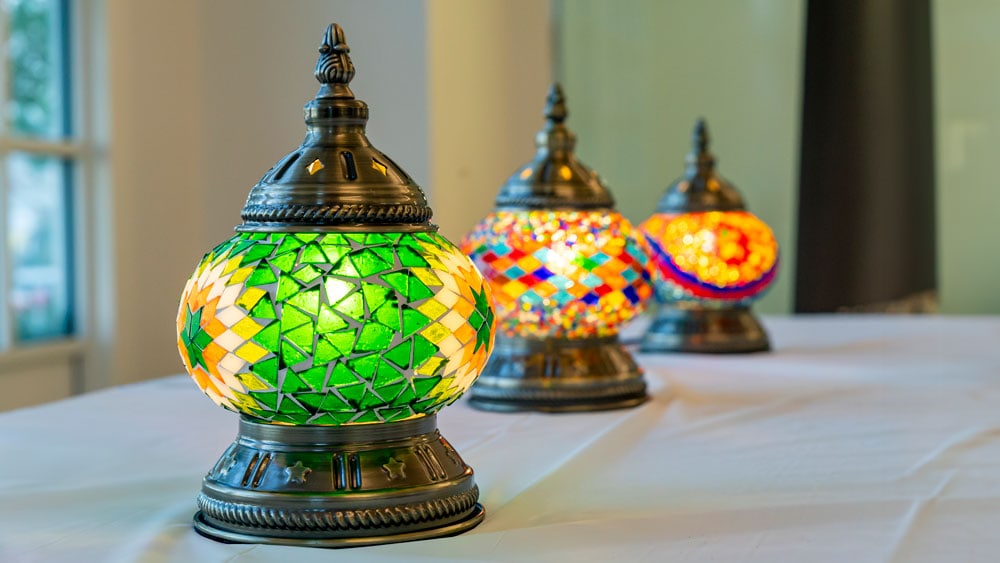
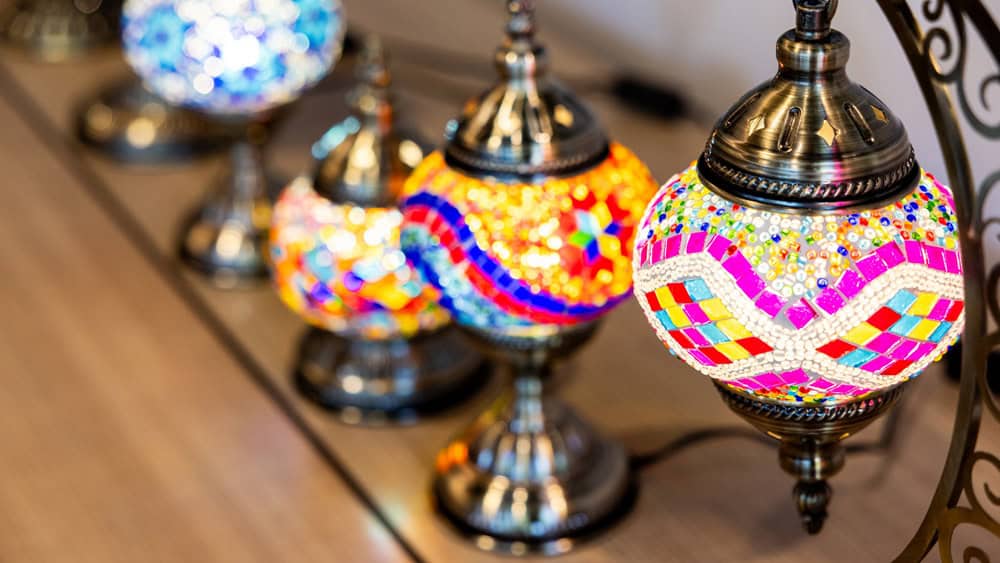
Possibly the most beloved living mosaic art tradition, Turkish mosaic lamps apply centuries-old Ottoman techniques to hand-blown glass globes. Each lamp combines hundreds of stained-glass pieces and beads in geometric and floral patterns that catch and refract light when illuminated. We'll cover these in detail later in this guide.
Other notable styles include pebble mosaic, Roman mosaic, Byzantine mosaic, mirror mosaic, and contemporary found-object mosaic, which uses everything from bottle caps and gears to costume jewelry.

Mosaic Art Techniques: How to Do Mosaic Art
Wondering how to do mosaic art? Modern mosaicists use four main techniques, each suited to different projects and skill levels. Understanding these methods is essential whether you're planning your first mosaic art kit project or stepping into a mosaic art class for the first time.
Direct Method
In the direct method, tesserae are glued face-up directly onto the final surface, wood, terracotta, glass, ceramic, or any other substrate. You watch your design develop in real time as you place each piece. This is the most beginner-friendly approach and is essential for three-dimensional projects like vases, sculptures, and, most importantly for our craft, Turkish mosaic lamps. Gaudí himself was a master of the direct method.
Indirect (Reverse) Method
Tesserae are placed face-down on a temporary backing (like Kraft paper or contact paper) using water-soluble glue. Once the design is complete, the entire mosaic is flipped and pressed face-up onto the final surface in fresh adhesive. Once everything sets, the temporary backing is dampened and peeled away. The result is a perfectly flat finished surface, ideal for tabletops, walking paths, and floors.
Double Direct Method (Mesh Method)
A practical hybrid: tesserae are glued face-up onto fiberglass mesh, then the entire mesh-and-mosaic assembly is later attached to the final surface with thinset mortar. This approach excels at large public installations, curved walls, and projects you need to transport between work sessions.
Double Indirect Method
The most complex of the four. Tesserae are arranged face-up on adhesive paper, a second sticky layer is pressed on top, and then the assembly is flipped before installation. This combines the visual feedback of the direct method with the flat finish of the indirect method, best left to experienced professionals on large commissioned works.
For most home mosaic art diy projects and beginner workshops, the direct method is the right choice. It's how we teach Turkish mosaic lamps at every Tiles Workshop event.

Materials for Mosaic Art
The materials for mosaic art fall into three essential categories: tesserae (the pieces), substrates (the base), and binders (adhesives and grout).
Tesserae (The Pieces)
The choice of tesserae shapes the entire character of your finished work. Common mosaic art materials include:
- Vitreous glass tiles — Kiln-fired opaque glass, uniform and durable. The standard for modern hobby projects.
- Smalti — Hand-cut Italian opaque glass. Brilliant, irregular, and prized for high-end work.
- Gold and silver smalti — Real metal leaf sandwiched between glass layers, used for divine light effects.
- Stained glass — Translucent sheet glass, cut by scoring and snapping.
- Ceramic tiles — Affordable, beginner-friendly, available in countless glazes.
- Stone and marble — Classical, natural, used since antiquity.
- Mirror fragments — Add reflective sparkle and depth.
- Glass beads — Small spherical pieces that fill gaps and add texture (essential in Turkish mosaic lamp work).
- Pebbles, shells, and found objects — For contemporary and trencadís-style mosaic art.
Substrates (The Base)
Mosaic art can be made on virtually any sturdy surface: wood, MDF, cement board, concrete, terracotta, fiberglass mesh, metal, and, of course, hand-blown glass globes for Turkish lamps. The choice depends entirely on the project's purpose and environment.
Adhesives and Grout
PVA glue (like Weldbond) is the gold standard for indoor mosaic art projects. For outdoor pieces, floors, and pool surrounds, you'll need thinset mortar, which is cement-based and waterproof. Mastic, a pre-mixed acrylic adhesive, works well on dry indoor walls. For glass-on-glass projects (like mosaic art lamp work), specialty silicone or epoxy adhesives are preferred.
Grout fills the gaps between tesserae after the adhesive has cured. Sanded grout is for joints wider than 1/8 inch, unsanded grout for finer work and delicate surfaces, and epoxy grout for the most durable, stain-resistant finish.

Mosaic Art Tools Every Artist Needs
A complete set of mosaic art tools doesn't have to be expensive, but having the right ones makes every project smoother and safer. Here are the essential mosaic art supplies every beginner and intermediate artist should know about.
- Wheeled glass cutters (also called "leps") — Two opposing wheels compress glass to create clean, precise cuts. Essential for vitreous glass, stained glass, and smalti.
- Tile nippers — Flat-edged compression cutters for ceramic, stone, and china. Don't use them on glass.
- Hammer and hardie — The traditional tool used since Roman times. The hardie is a chisel set into a wooden block; tesserae are placed on it and struck with the small hammer for clean, accurate cuts. Still considered the most precise way to cut smalti and marble.
- Tweezers — For placing tiny tesserae and beads with precision. Indispensable for Turkish mosaic lamp work.
- Glass scorer — For straight cuts on stained glass.
- Notched trowel — For spreading thinset mortar evenly.
- Grout float and sponge — For applying and cleaning grout.
- Safety goggles, dust mask, and gloves — Never optional. Cut glass produces sharp shards and fine dust.
- Mixing buckets and measuring cups — For preparing adhesives and grout.
- Pencils, paper, and design templates — For sketching your design before placing pieces.
If you're just starting out, a beginner mosaic kit typically bundles the essentials together so you don't need to source each tool separately. We'll talk about kits in just a moment.

Where Is Mosaic Art Used Today?
After more than five thousand years, mosaic art is more alive and accessible than ever. Modern applications fall into several main categories.
Public art and architecture are perhaps the most visible. Subway stations, airports, plazas, and public buildings around the world feature mosaic murals that turn ordinary commutes into encounters with art. Major examples include New York City's subway stations, Lisbon's azulejo-covered metro, and countless contemporary installations.
Home décor has embraced mosaic art in a big way. Backsplashes, accent walls, bathroom features, mosaic-topped tables, garden stepping stones, and decorative mirrors all bring the ancient craft into modern living spaces.
Functional art is a category that's grown rapidly in recent years. Turkish mosaic lamps, mosaic candleholders, mosaic-decorated furniture, jewelry, and even smartphone cases all combine practical use with artistic beauty.
Therapeutic and community art has emerged as one of the most exciting modern uses. Studies and personal accounts alike show that the slow, repetitive, focused process of placing tesserae produces a meditative state similar to mindfulness practice. Mosaic art workshop events are increasingly used for stress relief, creative therapy, and team building. Whether for a corporate team retreat, a bachelorette party, or a date night, a hands-on mosaic art group experience creates lasting memories that no painting class or escape room can match.

Mosaic Art for Beginners: How to Get Started
Good news: mosaic art for beginners is far more accessible than most people assume. You don't need years of training, expensive equipment, or formal art education. What you need is patience, curiosity, and the right starting project.
Choosing Your First Mosaic Art Kit
The fastest, easiest way to begin is with mosaic art kits for beginners or mosaic art kits for adults. A good kit removes guesswork by including everything you need: pre-cut tesserae in coordinated colors, a substrate (such as a candleholder or lamp globe), the right adhesive, instructions, and often a design template.
For first-timers, we especially recommend starting with smaller scale projects. A mosaic art kit focused on a candleholder, coaster, or small decorative object can be completed in a couple of hours and gives you all the foundational skills, color planning, adhesive application, piece placement, and finishing. From there, larger and more complex projects feel natural.
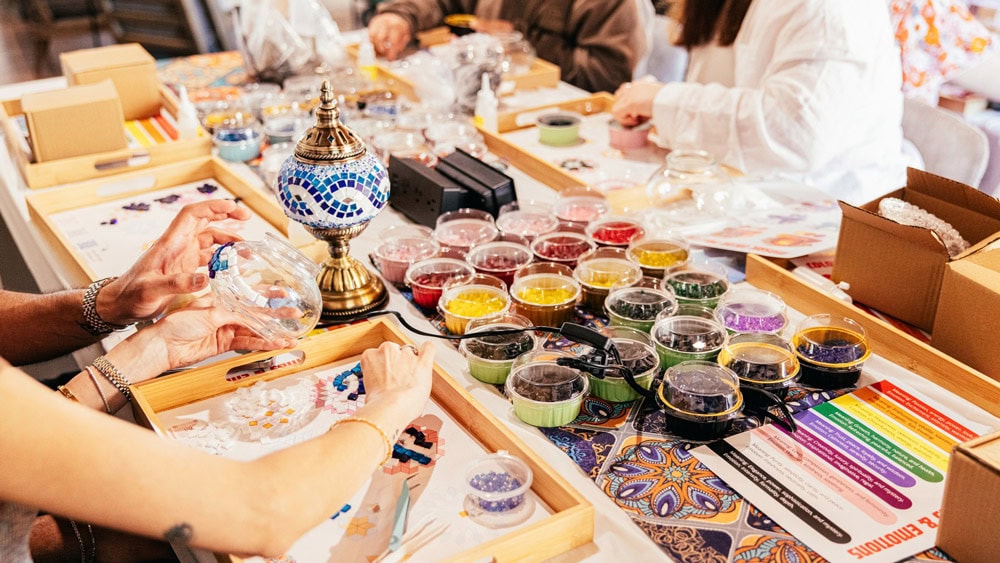
At Tiles Workshop, Turkish Mosaic Lamps DIY Kits are designed specifically with absolute beginners in mind. Each one bundles authentic stained glass, Czech glass beads, glass globe, brass base, professional adhesive, and step-by-step instructions, everything needed to create a real Turkish mosaic lamp at home.
Step-by-Step: Making a Turkish Mosaic Lamp
Here's exactly how a complete Turkish mosaic lamp comes together at our workshops or with one of our DIY kits. The whole process takes about two and a half hours of active work.
Step 1: Choose your lamp design
Begin by selecting your colors and pattern. Lay out your mosaic art tiles and beads on the design template before attaching anything to the lamp globe. This planning step ensures your final piece reflects your vision.
Step 2: Apply adhesive to the lamp globe
Add glass adhesive in small sections to the surface of the globe. Working in sections keeps the adhesive workable and gives you time to place pieces precisely.
Step 3: Place mosaic tiles and beads
Attach colorful glass tiles and beads one piece at a time, following your chosen design. This is where the meditative, calming nature of mosaic art really takes over, you'll find yourself fully absorbed in the work.
Step 4: Fill gaps and secure the design
Once your main pattern is in place, fill the remaining open spaces with smaller pieces and beads. Make sure all glass elements are firmly attached to the globe.
Step 5: Let the lamp dry
Allow the adhesive and filling material to dry completely. This curing period is essential before any further handling.
Step 6: Assemble the lamp
Attach the finished mosaic globe to the lamp base and wiring hardware to complete your handmade mosaic art lamp.
Step 7: Light and enjoy your mosaic lamp
Turn on your lamp and watch it transform any room into a glowing, kaleidoscopic display, a finished work of functional art made entirely by you.
Common Beginner Mistakes
Even with the right kit, a few simple pitfalls can catch beginners off guard. Tesserae that are too large for the design's level of detail, forgetting to leave consistent grout gaps, using the wrong adhesive for the project's environment, and rushing the grout cleanup phase are the four most common issues. The good news: every one of them is easy to avoid once you know to watch for them.
Is mosaic art difficult? Honestly, no, it requires patience, not advanced skill. The basic techniques can be learned in a single workshop session, and your first finished piece will look genuinely beautiful. Mastering the deeper aspects of color theory, andamento (the directional flow of tesserae), and complex compositions takes years, but creating wonderful work as a beginner is very much within reach.

Turkish Mosaic Lamps: A Living Mosaic Art Tradition
Of all the world's surviving mosaic art traditions, the Turkish mosaic lamp stands out for its accessibility, its breathtaking visual impact, and its direct lineage from one of history's greatest mosaic empires.
These lamps trace their origins to the 16th-century Ottoman Empire, when artisans in Istanbul drew on centuries of Byzantine glasswork and Persian geometric design to create ornate hanging and table lamps that illuminated sultans' palaces and grand mosques. The same techniques used by Byzantine mosaicists to glorify the dome of the Hagia Sophia were adapted to glowing globes that filled rooms with colored light.
Today, every authentic Turkish mosaic lamp is still entirely handcrafted using traditional methods. Artisans begin with a hand-blown clear glass globe, cut hundreds of pieces of stained glass and Czech glass beads by hand, and arrange them into traditional Ottoman patterns directly on the globe. The gaps are filled with a traditional plaster paste that holds everything in place and reflects light beautifully when the lamp is illuminated. Finally, the finished globe is mounted on a hand-hammered brass or bronze base.
The colors carry deep symbolic meaning rooted in Anatolian culture: blue represents protection and the nazar tradition; turquoise evokes healing and the Aegean Sea; red speaks of passion and Istanbul's spice markets; yellow and amber suggest joy and Mediterranean sunlight; green stands for prosperity, peace, and nature. Star patterns symbolize protection and divine guidance, while geometric repetition reflects the Islamic concept of infinite divine order.
This is exactly why Turkish mosaic lamps aren't just decorations, they're functional art objects descended in an unbroken line from the same Byzantine and Ottoman traditions that produced some of the most celebrated famous mosaic art in human history. To learn more about this tradition, explore our complete guide to Turkish Lamps.
Find a Mosaic Art Studio or Class Near You
Looking up "mosaic classes near me" "mosaic art studio near me" or "mosaic art classes near me"? You're joining a wave of creative seekers discovering that hands-on art experiences are some of the most rewarding things a person can do, whether for a date night, a bachelorette party, a corporate team-building event, a birthday celebration, or simply a quiet afternoon devoted to making something with your own hands.
At Tiles Workshop, we specialize in the Turkish mosaic lamp tradition for participants across the United States. We offer two ways to experience this living mosaic art tradition:
In-person Mosaic Lamp Workshop sessions — Our Turkish Mosaic Lamp Workshop Events welcome complete beginners. Over two to three hours, you'll work with authentic hand-cut Istanbul stained glass, real brass bases, and traditional plaster grout, guided every step of the way by experienced artisans. These workshops are perfect for date nights, birthday parties, bachelorette parties, corporate team building, private group events, and family gatherings.
Take-home DIY kits — If you'd rather create at your own pace, our Turkish Lamps Mosaic DIY Kits include everything needed to make a stunning mosaic lamp at home. New to mosaic art? Our Candle Holder Turkish Lamp Kit is our most beginner-friendly option and a perfect introduction to mosaic art kits for adults.
To plan a private group event, ask about custom workshops, or find out about scheduling, contact us. We ship our kits anywhere in the United States and host workshop events in multiple cities.

Frequently Asked Questions
What is mosaic art?
Mosaic art is the technique of creating images, patterns, or surface decorations by arranging small pieces of colored stone, glass, ceramic, or other materials, called tesserae, onto a prepared surface using adhesive or mortar. Each individual tessera is a fragment, but together they form complete artworks that can range from small decorative objects to massive architectural installations.
What is the meaning of mosaic art?
The mosaic art meaning goes beyond technique. The word comes from the Greek Mouseion, shrine of the Muses, meaning "work of inspiration." Symbolically, mosaic art represents the creation of unity from fragments, beauty from broken pieces, and order from chaos. Every mosaic is a small lesson that small things, arranged with patience, can become something extraordinary.
Where did mosaic art originate?
Mosaic art originated in ancient Mesopotamia, roughly modern-day Iraq, around 3,000 BCE. The Sumerians of Uruk decorated temple columns with colored terra-cotta cones, and the temple of Abra contained some of the earliest mixed-material mosaics ever found. The art form then spread to Greece, the Roman Empire, the Byzantine world, and beyond.
What are the three main types of mosaics?
The three classical types of mosaic art are opus tessellatum (uniform square or rectangular tesserae used for large fields), opus vermiculatum (tiny tesserae in worm-like rows used for fine detail), and opus sectile (large pieces cut into specific shapes, fitted like a jigsaw). Many modern teachers also classify mosaics by material: stone, glass, and ceramic.
What is the most famous mosaic art in the world?
The most frequently cited candidates are the Alexander Mosaic from Pompeii (over one million tesserae depicting Alexander the Great's victory at the Battle of Issus) and the Deësis mosaic in Hagia Sophia, Istanbul. Park Güell's salamander, designed by Antoni Gaudí, is the most famous modern example of mosaic art.
How to do mosaic art for beginners?
Start with a mosaic art kit that includes pre-cut tesserae, a small substrate, and detailed instructions. Use the direct method: glue pieces face-up onto your surface, leave consistent gaps between them, let the adhesive cure for 24 hours, then apply grout and clean. A small candleholder, coaster, or beginner-friendly Turkish mosaic lamp is ideal for your first project.
What materials are used in mosaic art?
The main materials for mosaic art include tesserae (vitreous glass, smalti, stained glass, ceramic, stone, marble, mirror, beads, and pebbles), substrates (wood, cement board, terracotta, glass globes), adhesives (PVA glue, thinset mortar, mastic), and grout. Each material brings its own visual qualities to the finished work.
What are mosaic art tools?
Essential mosaic art tools include wheeled glass cutters, tile nippers, hammer and hardie (the traditional cutting tool), tweezers, a glass scorer, notched trowel, grout float and sponge, safety goggles, and a dust mask. Most beginners can start with just wheeled cutters, tile nippers, and a basic safety kit.
Is mosaic art difficult?
Not at all, mosaic art requires patience much more than advanced skill. The fundamentals can be learned in a single two- or three-hour workshop session, and beginners regularly create stunning first pieces. Mastering complex compositions, advanced color theory, and andamento takes years, but creating beautiful work right from the start is very achievable.
What is the difference between mosaic and mosaic art?
In everyday speech, "mosaic" can refer to any tiled surface, including factory-made mosaic tile sheets used in bathrooms and kitchens. Mosaic art specifically refers to the creative practice of designing and assembling original artistic compositions from tesserae. All mosaic art involves mosaic technique, but not every mosaic is mosaic art.
Are Turkish mosaic lamps real mosaic art?
Absolutely. Turkish mosaic lamps use the direct method with authentic hand-cut stained glass and beads, descend directly from Byzantine and Ottoman mosaic art traditions, and follow the same fundamental principles as floor and wall mosaics. They represent mosaic art applied to a three-dimensional illuminated form, genuinely one of the most beautiful living branches of the broader tradition.
How long does a mosaic art project take?
A small kit-based project like a coaster or candleholder takes about one to three hours of active work plus 24 hours of curing time. A complete Turkish mosaic lamp at one of our workshops takes about two to three hours from start to finish. Larger architectural mosaics can take months or years for professional installations.
Where can I find mosaic art classes near me?
Search for "mosaic art class" "mosaic class near me" or "Turkish mosaic lamp workshop" in your area. If you're in the United States, contact Tiles Workshop, we host workshop events for individuals, couples, and private groups in multiple cities and ship our DIY kits nationwide.
Conclusion: Become Part of a 5,000-Year Story
Mosaic art is one of humanity's oldest and most enduring creative traditions. From the colored cones of ancient Mesopotamia to the gold-leaf vaults of the Hagia Sophia, from Gaudí's playful salamanders in Barcelona to the warm glow of an Ottoman-style lamp on a modern coffee table, the same impulse runs through every mosaic ever made: the desire to take small, ordinary fragments and transform them, piece by patient piece, into something whole, luminous, and lasting.
You don't need formal training, expensive equipment, or any artistic background to participate in this remarkable tradition. You just need a few hours, a little patience, and the willingness to slow down and create something with your hands.
Ready to make your own piece of mosaic art?
- Book a Turkish Mosaic Lamp Workshop for a date night, party, or team event
- Browse our Turkish Mosaic Lamps DIY Kits to create at home
- Start small with our beginner-friendly Candle Holder Turkish Lamp Kit
- Contact Tiles Workshop for private groups, custom events, and mosaic art classes near me inquiries
Five thousand years ago, someone in Mesopotamia pressed the very first colored cone into a temple wall. Today, the next piece of the mosaic art story could be yours.
-----
References
- Wikipedia – Mosaic [https://en.wikipedia.org/wiki/Mosaic]
- Britannica – Mosaic Art [https://www.britannica.com/art/mosaic-art]
- The British Museum – [https://www.britishmuseum.org/]
- UNESCO World Heritage – [https://whc.unesco.org/]